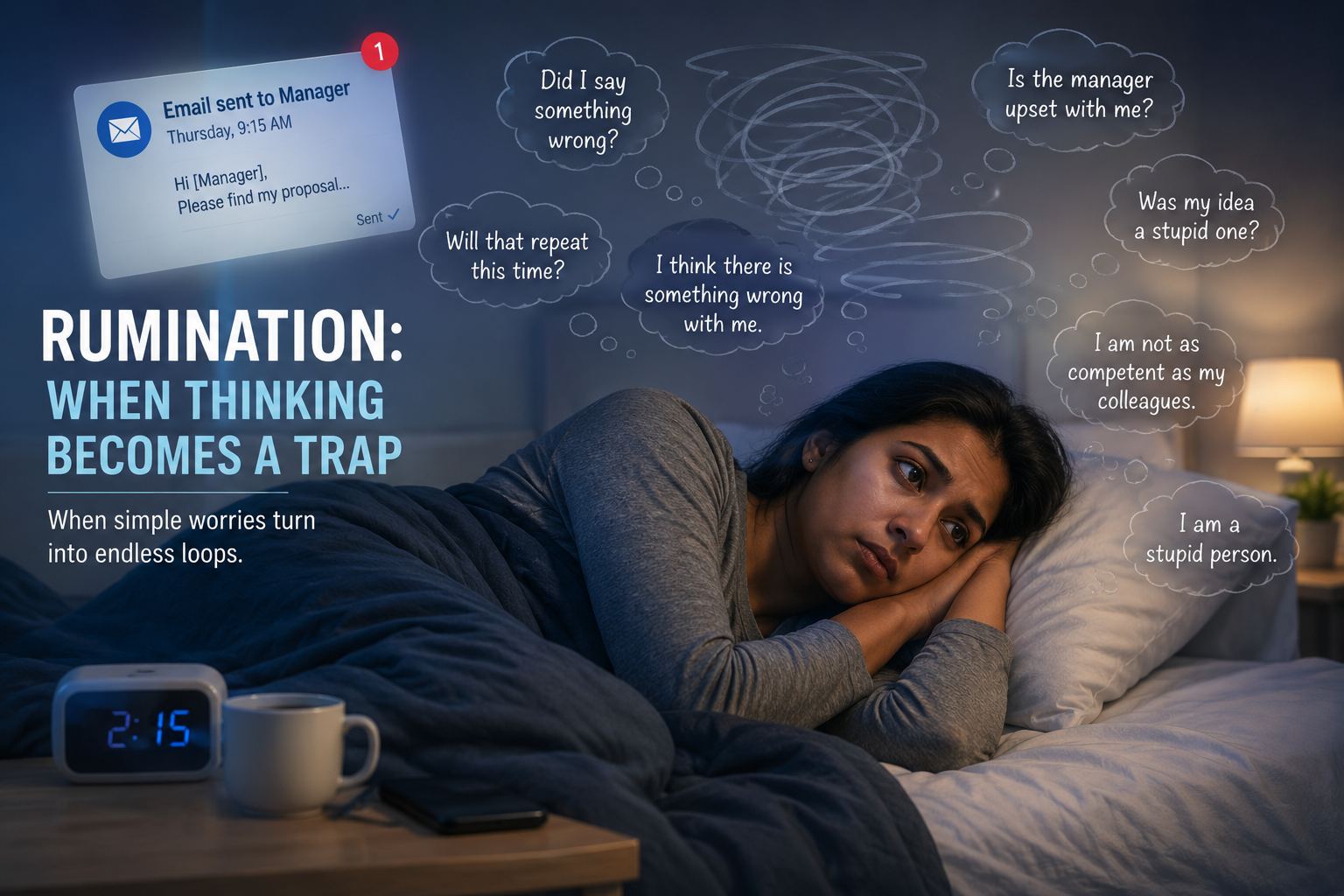
Tania sent an email to her manager on Thursday morning. By Friday evening, she still had not received a reply. As she lay in bed, a flood of thoughts rushed through her mind: Did I say something wrong? Is the manager upset with me? Was my idea a stupid one? She recollected incidents from the past where she received negative responses and treatments from others and got worried. Will that repeat this time? Is the manager going to respond negatively? I think there is something wrong with me. I am not as competent as my colleagues. I am a stupid person. What began as simple doubts, soon turned into brooding over the past leading Tania to draw harsh and negative conclusions about herself. She re-read the email repeatedly and analysed every word she had written.
She received a proper and normal response from the manager on Saturday but still Tania couldn’t stop thinking and worried about it. A simple unanswered email turned into hours of worry, self-doubt and mental exhaustion.
Tania’s story reflects an experience that many people encounter in their daily life. The story illustrates ‘Rumination’, the tendency to repeatedly and compulsively dwell on one’s distress, its causes and consequences rather than engaging in active problem solving. Rumination keeps us trapped in a loop of overthinking and increases stress, anxiety and depression.
“We ruminate on suffering, regret, and sorrow. We chew on them, swallow them, bring them back up, and eat them again and again. If we’re feeding our suffering while we’re walking, working, eating, or talking, we are making ourselves victims of the ghosts of the past… We’re not living our lives.” :Thich Nhat Hanh (Zen Master & Author).
But why does the mind do this? Why are we human beings so inclined to revisit our mistakes and failures, replay distressing conversations and mentally rehearse the alternative versions of the past? The answer lies in the complex interaction between our evolutionary history, emotional needs and psychological defenses.
The brain working on an unsolved issue
Rumination is often the brain’s attempt to resolve something that’s perceived as unfinished. Humans are naturally meaning makers and our minds return to events, situations or interactions in search for clarity, meaning and certainty. It asks: What did they really mean? Why did I react that way? What should I have said? How can I prevent this from happening again? Here the brain’s assumption is that, if it thinks long enough, it will get clarity and solution. Healthy reflections can help the brain achieve this. But rumination is not productive as reflections, because it is repetitive, too self-critical, emotionally charged and disconnected from effective actions. Research shows that rumination does not produce insights. It does not facilitate but interferes with effective problem solving. In this sense rumination is often a failed attempt of the brain at emotional problem solving.
The Neuro Science of Rumination
Neuro science says that high rumination involves increased activity in brain networks associated with self-referential thinking, particularly the Default Mode Network (DMN). DMN is the system involved in self-reflection, daydreaming and inward focused thinking. When functioning well, this network supports reflection and self-understanding. During depression, rumination keeps this network excessively active making it harder for individuals to disengage from distressing thoughts. Then, the brain essentially becomes caught in a loop, repeatedly revisiting the same emotional territory.

Mental Quicksand
Rumination is more than just a temporary habit of over-thinking. For some people it becomes a long term thinking pattern that increases their vulnerability to depression. People who tend to dwell repeatedly on negative thoughts and experiences, may be more likely to develop depressive episodes and find it harder to recover from them. For this reason, rumination is described as ‘mental quicksand’ because the more one thinks the way out of one’s emotional struggles, the deeper one sinks into them.
Common Symptom of Major Depressive Disorder
Rumination is recognized as one of the most important cognitive symptoms of MDD. It not only deepens negative moods, but also prolongs depressive episodes and increases the likelihood of relapses. Many psychological interventions such as Mindfulness practices and Rumination Focused Cognitive Behavioral Therapy (RF-CBT) have been helpful to reduce rumination. Anti-depressants can help reduce rumination, but not always. Current evidence suggests that rumination cannot be addressed through medication alone but needs to combine medication with psychological therapies that specifically target rumination.
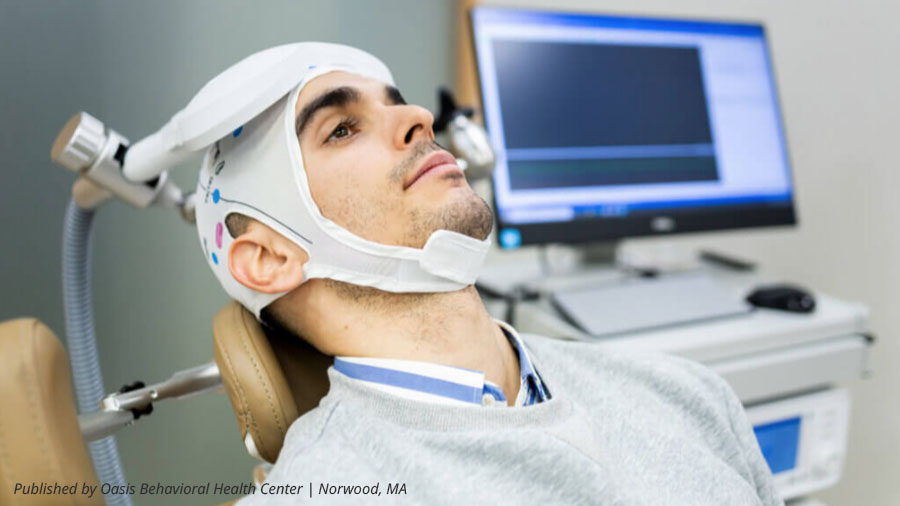
Severe rumination has been associated with reduced effectiveness of pharmacological and psychotherapeutic interventions, particularly in women. People who ruminate heavily, often take longer to respond to treatment and may experience more persistent symptoms. But research (Chu et al. (2023)) shows that ruminative symptoms in treatment resistant-major depressive disorder are responsive to repetitive Transcranial Magnetic Stimulation (rTMS) treatment of MDD. rTMS is a non-invasive brain stimulation treatment that is increasingly used for treatment resistant depression. Evidence indicates that rTMS may be effective in reducing both depressive symptoms and the tendency to ruminate.
You are not alone
Do you find yourself trapped in the loop of rumination and struggling with persistent feelings of sadness and hopelessness? The team of experts in OBHI is here to help you. Your repetitive cycle of overthinking can be a sign of underlying emotional distress, depression, anxiety, unresolved experiences or any other psychological conditions. The mental health professionals in OBHI will help you to understand the nature and intensity of your rumination and underlying reasons through a comprehensive assessment. Based on this understanding, they will help you choose the best treatment approach whether that involves counselling, psychotherapy, pharmacotherapy, rTMS or a combination of supports.
You don’t have to navigate this struggle alone. With the right support, you can break free from the cycle of rumination, regain emotional balance and move forward with greater clarity and confidence.