If you or someone you love has struggled with depression that hasn't responded to antidepressants or therapy, you may have heard about TMS — Transcranial Magnetic Stimulation. But what exactly is it, how does it work, and could it be right for you? At Oasis Behavioral Health Center in Norwood, MA, we specialize in this breakthrough treatment. Here's everything you need to know.
What Is TMS?
Transcranial Magnetic Stimulation (TMS) is a non-invasive, FDA-approved treatment that uses magnetic pulses to stimulate specific areas of the brain involved in mood regulation — primarily the prefrontal cortex. Unlike antidepressant medications, which affect the entire body, TMS directly targets neural activity in the brain without systemic side effects like weight gain, fatigue, or sexual dysfunction.
TMS has been FDA-approved to treat depression since 2008, and as of 2024, it is also approved for adolescents aged 15 and older. It is also cleared for obsessive-compulsive disorder (OCD) and certain types of migraine.
How Does TMS Work?
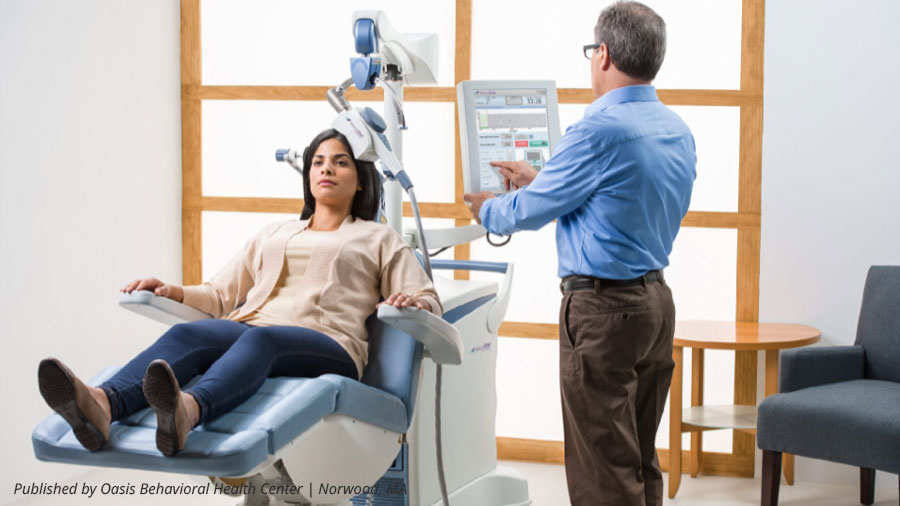
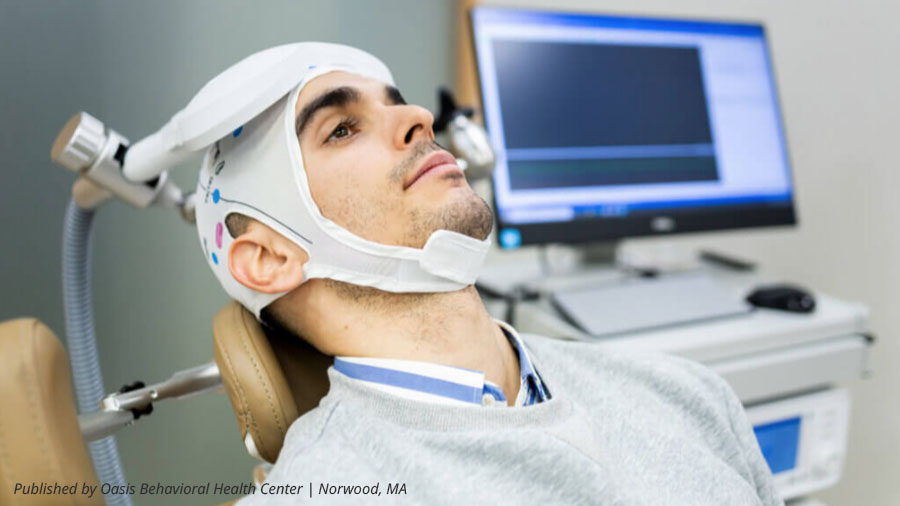
During a TMS session, a clinician places an electromagnetic coil against the patient's scalp. The device delivers precisely targeted magnetic pulses that pass painlessly through the skull and stimulate nerve cells in the dorsolateral prefrontal cortex — the area of the brain most strongly linked to depression. These pulses induce small electric currents that reset dysfunctional brain patterns associated with depression, essentially helping to regulate mood over the course of treatment.
Before treatments begin, your provider will identify the ideal stimulation target and intensity by first locating the motor cortex — a landmark in the brain — and using calculations to map the treatment coil to the best location for your individual brain anatomy.
Patients remain fully awake and seated in a comfortable chair throughout each session. No anesthesia is required, and patients can drive themselves home immediately afterward.
What Does a TMS Treatment Course Look Like?
A standard TMS course typically involves sessions five days a week for four to six weeks — roughly 30 to 36 sessions for most depression protocols, though this varies by device and diagnosis. Each session lasts anywhere from 20 to 50 minutes. Some newer accelerated programs, such as theta burst stimulation (TBS), deliver multiple brief sessions per day over approximately five days, significantly shortening the overall treatment timeline.
Patients are asked to remove any magnetic-sensitive objects such as jewelry or hearing aids before treatment and wear earplugs during sessions, as the TMS device produces a clicking sound with each pulse.
Who Is TMS For?
TMS is typically recommended after antidepressants and psychotherapy have not provided adequate relief. You may be a good candidate for TMS if you:
- Have tried one or more antidepressants without satisfactory results
- Have experienced negative side effects from antidepressant medications
- Have a diagnosis of major depressive disorder (MDD)
- Prefer a medication-free treatment option
TMS is generally not recommended for individuals with a history of seizures, certain neurological conditions, or metal implants in the head or neck area (such as cochlear implants or aneurysm clips). A thorough evaluation with one of our psychiatrists will determine if TMS is safe and appropriate for you.
Is TMS Safe?
TMS is considered as safe as having an MRI scan and does not involve radiation. The most common side effects are mild and temporary — typically minor scalp discomfort or brief headaches during or after sessions. These can often be managed by adjusting the intensity or position of the coil. Serious side effects are very rare.
Research has found that TMS is well-tolerated over the long term, with patients undergoing TMS for up to a year reporting sustained safety and tolerability with only minor, manageable side effects.
Ready to Learn More?
At Oasis Behavioral Health Center, TMS treatments are performed under the direct care of our board-certified psychiatrists, combining cutting-edge science with compassionate support. We accept most major insurance plans and are conveniently located on Route 1 in Norwood, MA.
Call us today at (617) 401-7700 or visit obhi.org to schedule a consultation.
Works Cited
Trapp, N.T., et al. (2025). Consensus review and considerations on TMS to treat depression. Clinical Neurophysiology, 170, 206-233.
https://doi.org/10.1016/j.clinph.2024.12.015
Cleveland Clinic. (2026, February). Transcranial Magnetic Stimulation (TMS): What It Is.
https://my.clevelandclinic.org/health/treatments/17827-transcranial-magnetic-stimulation-tms
Harvard Health Publishing. (2020). Transcranial magnetic stimulation for depression. Harvard Medical School.
https://www.health.harvard.edu/blog/transcranial-magnetic-stimulation-for-depression-2018022313335
U.S. Department of Veterans Affairs. (n.d.). Transcranial Magnetic Stimulation (TMS) – Treatment for Depression. VA Montana Health Care.
https://www.va.gov/montana-health-care/programs/transcranial-magnetic-stimulation-tms-treatment-for-depression/
Yale Medicine. (n.d.). Transcranial Magnetic Stimulation (TMS) for Depression, OCD: What to Know.
https://www.yalemedicine.org/news/transcranial-magnetic-stimulation-tms-what-you-need-to-know
Montana Psychiatry & Brain Health Center. (2025, July). Who Is a Good Candidate for TMS Therapy?
https://mtpsychiatry.com/2025/07/09/who-is-a-good-candidate-for-tms-therapy/
American Journal of Psychiatry. (as cited in Tri-County Behavioral Health, 2024). TMS therapy long-term safety and tolerability findings.