
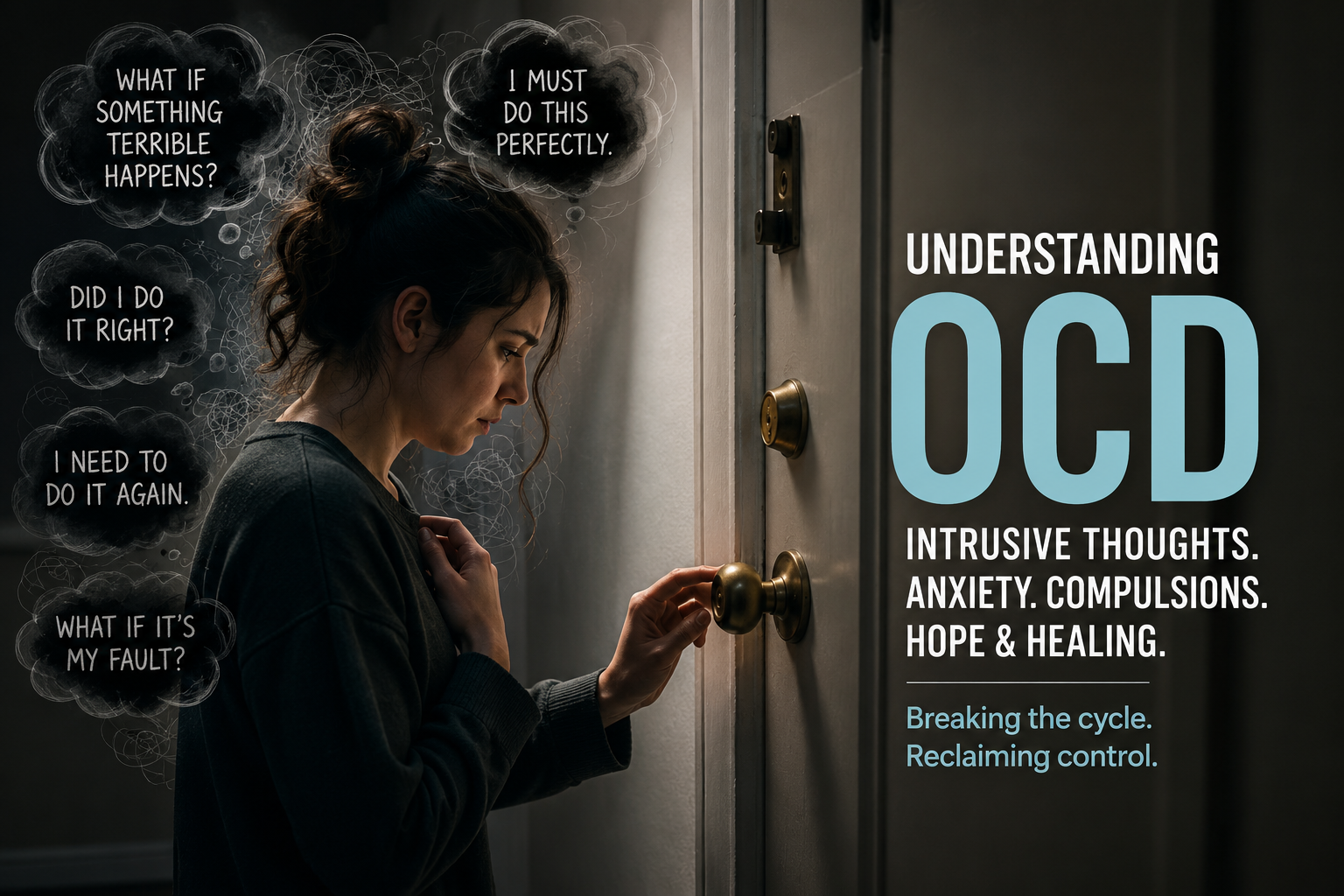
Sarah stands in front of her apartment door, her car keys biting into her palm. She is already twenty minutes late for work.
To anyone passing by in the hallway, she is simply staring at the brass handle. But inside Sarah’s mind, a catastrophic storm is raging.
An intrusive, unwanted thought has locked her in place:
“If you do not touch this doorknob exactly four times while thinking of your mother, she will die in a car accident today.”
She reaches out and taps it.
One.
Two.
Three.
On the fourth tap, a siren blares outside, breaking her concentration. The thought suddenly feels “contaminated.” The ritual no longer feels complete. Her mind insists she must start again.
Her heart races. Her hands tremble. She knows this makes no logical sense. She desperately wants to leave.
But another thought appears:
“What if this time it really is your fault?”
Sarah touches the doorknob again.
This is not perfectionism.
This is not superstition.
This is Obsessive-Compulsive Disorder (OCD) a condition where the brain traps people in an exhausting cycle of intrusive thoughts, overwhelming anxiety, and repetitive behaviors performed simply to obtain a few moments of relief.
OCD Is Not About Being “Neat”
Popular culture has reduced OCD to a personality quirk. People casually say, “I’m so OCD,” because they like tidy desks or color-coded bookshelves. This stereotype is not only inaccurate,it is deeply harmful.
Obsessive-Compulsive Disorder (OCD) is a chronic neuropsychiatric disorder characterized by obsessions (intrusive, distressing thoughts, images, or urges) and compulsions (repetitive behaviors or mental acts performed to reduce anxiety or prevent a feared outcome). It affects approximately 1–3% of people worldwide during their lifetime. Research shows that OCD involves dysfunction within specific brain circuits, particularly the cortico-striato-thalamo-cortical (CSTC) circuit, along with alterations in neurotransmitters such as serotonin and glutamate. It is therefore recognized as a neurological and psychiatric condition, not a personality trait or a lack of willpower.
The Obsession: An Intrusive Thought Appears
Everything begins with an obsession. Obsessions are unwanted, intrusive thoughts, images, sensations, or urges that enter consciousness without invitation. They often contradict a person’s values, making them particularly distressing.
Examples include:
“If I don’t touch this door, something terrible will happen.”
“This side of my body feels wrong.”
“The stove may still be on.”
“If I don’t complete this correctly, someone I love will be harmed.”
“I touched that object incorrectly.”
Importantly, individuals with OCD usually recognize that these thoughts are irrational or excessive. Yet insight alone cannot stop them.
The Anxiety: The Brain Sounds a False Alarm
The obsession immediately triggers intense anxiety. People often describe- racing heartbeat, muscle tension, nausea, panic, overwhelming dread, feelings that something is “not just right”,unbearable mental discomfort Neuroscientists often compare OCD to a brain alarm system that becomes stuck in the “danger” position. Even when no real threat exists, the brain continues
The Compulsion: Performing a Ritual to Reduce Distress
Unable to tolerate the overwhelming anxiety created by the obsession, the person performs a compulsion, a repetitive behavior or mental act intended to reduce distress or prevent a feared outcome. Compulsions are not performed because they are enjoyable or logical. Instead, they are driven by an urgent need to neutralize anxiety, achieve a sense of certainty, or make things feel “just right.” Although they may provide temporary relief, the anxiety soon returns, reinforcing the cycle. Compulsions can take many forms, including:
- Touching a doorknob exactly four times before leaving the house.
- Tapping a wall, desk, or other object repeatedly until it “feels right.”
- Touching objects with both hands to create a sense of symmetry or balance.
- Repeatedly checking locks, doors, windows, or stove knobs by physically feeling them, even after visually confirming they are secure.
- Washing or sanitizing hands repeatedly because of fears of contamination.
- Rearranging or aligning objects until they appear perfectly symmetrical or “just right.”
- Counting steps, taps, or other actions according to specific numbers, such as 3, 4, or 7.
- Repeating routine actions—such as sitting down, standing up, entering a room, or rereading a sentence—until they feel complete.
- Seeking repeated reassurance from family members or friends, asking questions like, “Are you sure everything is okay?” or “Did I do the right thing?”
- Mentally repeating prayers, words, phrases, or numbers to neutralize a disturbing thought.
- Avoiding stepping on cracks, certain colors, numbers, or specific objects because they are believed to bring harm.
- Touching a loved one’s belongings before leaving home to prevent imagined harm from coming to them.
Although these rituals may look very different from one person to another, they all serve the same purpose: to reduce anxiety or prevent a feared consequence.
The Trap: Temporary Relief Reinforces the Cycle
The relief feels immediate, but unfortunately, it is only temporary.. Soon another intrusive thought appears.
“What if you didn’t touch it correctly?” ,”What if you counted wrong?”, “What if you have to start again?”

The cycle repeats. This process is known as negative reinforcement. Each time a compulsion is performed, the brain mistakenly learns that the ritual prevented the feared event, making it more likely that the person will feel compelled to repeat the behavior the next time anxiety strikes. Over time, compulsions often become longer, more frequent, and increasingly difficult to resist. This is what keeps OCD trapped in its self-perpetuating cycle.
Medication Treatment (Pharmacotherapy)
Medication is effective and recommended for individuals with moderate to severe symptoms, or when OCD significantly interferes with daily functioning. The first-line medications are Selective Serotonin Reuptake Inhibitors (SSRIs. For individuals who continue to experience significant symptoms despite adequate trials of medication and ERP, a psychiatrist may recommend carefully selected augmentation strategies as part of a comprehensive treatment plan. Medication should always be prescribed and monitored by a qualified healthcare professional and is often most effective when combined with Exposure , Response Prevention (ERP) and other treatment approaches.
The Path to Recovery: ERP Therapy and TMS
The encouraging news is that OCD is highly treatable. While recovery does not mean never experiencing intrusive thoughts again, effective treatment can significantly reduce symptoms and help people regain control of their lives.

Exposure and Response Prevention (ERP)
The most effective psychological treatment for OCD is Exposure and Response Prevention (ERP), a specialized form of Cognitive Behavioral Therapy (CBT). ERP works by helping individuals gradually face situations that trigger obsessive fears while resisting the urge to perform compulsions. For someone with a touching compulsion, this might involve touching a doorknob once and then deliberately walking away without repeating the ritual. Initially, anxiety increases. However, with repeated practice, the brain begins to learn an important lesson:
- The feared catastrophe does not occur.
- Anxiety naturally rises and falls on its own.
- Compulsions are not necessary for safety.
Over time, this process weakens the association between intrusive thoughts and compulsive behaviors, allowing individuals to respond with greater flexibility rather than fear. ERP should always be conducted under the guidance of a qualified mental health professional experienced in treating OCD, as exposures are carefully planned and individualized.
Transcranial Magnetic Stimulation (TMS): An effective Option for Treatment-Resistant OCD
For some individuals, OCD symptoms remain severe despite evidence-based treatments such as ERP and medication. In these cases, Transcranial Magnetic Stimulation (TMS) can be considered as an additional treatment option. TMS is a non-invasive procedure that uses magnetic pulses to stimulate specific areas of the brain involved in OCD, particularly networks associated with obsessive thoughts and compulsive behaviors. It does not require anesthesia and is typically performed on an outpatient basis.
The U.S. Food and Drug Administration (FDA) has cleared TMS protocols for adults with OCD who have not responded adequately to conventional treatments. Evidence suggests TMS can reduce OCD symptom severity for some people, particularly when integrated into a comprehensive treatment plan that includes psychotherapy and, where appropriate, medication. With accurate diagnosis, compassionate support, and evidence-based treatments many individuals learn that they do not need to obey every intrusive thought their brain presents.